
NASA Explores Options for Relocating Space Shuttle Discovery
NASA has issued a draft request to explore relocating the Space Shuttle Discovery or smaller spacecraft. This follows a law aiming to exhibit Discovery at Space Center Houston.
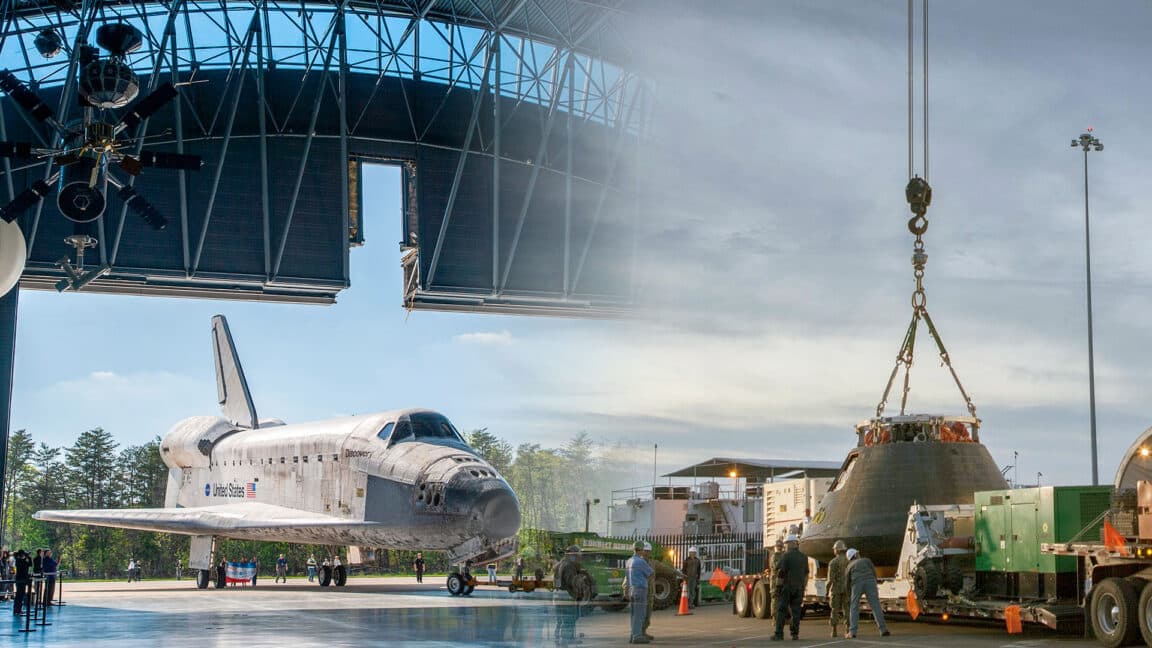
NASA has initiated a process to assess the logistics of relocating the Space Shuttle Discovery from the Smithsonian in Virginia to Houston, Texas, as well as the transport of smaller spacecraft from various locations across the country.
On March 19, the space agency released a draft request for proposals (DRFP) regarding the "NASA Flown Space Vehicle Multimodal Transportation Multiple Award Contract." This request aims to gather insights on how contractors might approach the transportation of both large aerospace vehicles and smaller spacecraft capsules.
This pre-solicitation is part of NASA's compliance with the One Big Beautiful Bill Act, which mandates the agency to move a vehicle that has flown with humans in space to a non-profit display facility near a center associated with the commercial crew program. While Texas Senators John Cornyn and Ted Cruz intended for this legislation to facilitate Discovery's exhibition at Space Center Houston, the language of the bill was crafted to be less specific.
Senator Cornyn expressed his support for the initiative, stating, "My law authorizing and funding the space shuttle Discovery’s movement to Houston is being set into motion thanks to NASA’s announcement, and I applaud Administrator Isaacman for keeping this process moving." However, the law allows for the potential delivery of an alternate artifact to Houston, as noted by Administrator Isaacman in December 2025.
Isaacman emphasized the importance of managing the budget for this transportation, stating, "My job now is to ensure that we can undertake such a transportation of Discovery within the budget dollars that we have available. And of course, most importantly, ensuring the safety of the vehicle." He also pointed out that if relocating Discovery is not feasible, NASA has other spacecraft, such as those involved in the Artemis program, which are currently in operation.
The draft RFP does not indicate a preference for either outcome, instead presenting both scenarios as illustrative examples. It requests detailed responses, limited to 40 pages, on the requirements for each option, including engineering analyses, transportation planning, preservation measures, specialized rigging systems, infrastructure coordination, regulatory compliance, and overall transportation execution.
One example in the draft refers to the potential relocation of a large aerospace vehicle, akin to a space shuttle orbiter or solid rocket booster. The second example focuses on transporting a smaller spacecraft capsule, similar to an Orion crew module or Mercury capsule. These examples are designed to encompass the various transportation scenarios that NASA may need to support under this contract.
NASA is also looking for cost estimates, although these will not be binding price proposals, to help plan and execute each of the moves within a five-year timeframe.
As indicated by the term "multimodal" in the title, NASA expects that multiple types of transportation will be utilized for these deliveries. The agency allows respondents to propose different methods, such as airlift, sealift, rail transport, overland heavy haul transport, and barge transport, among other specialized transport options.
Regardless of the transportation method chosen, contractors will be responsible for providing the necessary rigging to safely hoist and cradle the spacecraft during its relocation. NASA will not provide any of its own infrastructure, as it is assumed that the specialized equipment used for lifting the orbiters has been disposed of, following the installation of Endeavour at the California Science Center.
The contractor will also need to ensure artifact preservation and curatorial support, focused on maintaining the physical condition, structural integrity, finish, configuration, and historical authenticity of the spacecraft being transported. As Isaacman noted, these artifacts must be treated as valuable cargo that are irreplaceable national assets requiring careful handling and documentation.
Following NASA's first lunar missions in the mid-1970s, all Apollo command modules were transferred to the Smithsonian, which later arranged for their delivery to various museums across the globe. Due to budget constraints, NASA managed the retirement of the four remaining shuttle orbiters in 2011, with the National Air and Space Museum taking over the title for Discovery.
The provision within the One Big Beautiful Bill Act necessitating the DRFP indicates that NASA is looking to establish a long-term capability for transportation operations encompassing both small spacecraft capsules and large aerospace vehicles.
Even if Senators Cornyn and Cruz do not succeed in relocating Discovery to Houston, the responses to this request may facilitate the transport of future flown Orion capsules and other hardware to museums in years to come.