
NASA Investigates Risks of New Methane Rocket Fuel Explosions
NASA and the US Space Force are studying the dangers of exploding methane-fueled rockets to enhance safety protocols for future launches.
For over 60 years, the launch industry has predominantly relied on a mix of liquid and solid propellants. Refined kerosene has been favored for its easy handling and non-toxicity, while hydrazine is valued for its storability and simplicity. Hydrogen is recognized for its efficiency, and solid fuels are preferred for their long shelf life and quick launch capability.
In recent years, rocket manufacturers have increasingly focused on the development of large methane-fueled engines. Companies like SpaceX and Blue Origin have created powerful engines—namely the Raptor and BE-4—that each produce over half a million pounds of thrust. SpaceX’s Starship rocket utilizes 39 Raptor engines, while Blue Origin’s New Glenn and United Launch Alliance’s Vulcan rockets are equipped with fewer BE-4 engines.
Methane engines burn in conjunction with liquid oxygen and offer several advantages. They produce less sooty residue than kerosene, making them more suitable for reusable engines. Additionally, methane is easier to handle than liquid hydrogen, which is prone to leaks and must be stored at extremely low temperatures of around minus 423 degrees Fahrenheit (minus 253 degrees Celsius). Methane, while also a cryogenic liquid, is stored at relatively warmer temperatures between minus 260 and minus 297 degrees Fahrenheit (minus 162 to minus 183 degrees Celsius).
A Chinese rocket achieved the milestone of being the first methane-fueled launcher to reach orbit in 2023. In the United States, companies such as Rocket Lab, Stoke Space, and Relativity Space are also working on methane-fueled engines for their upcoming launch vehicles.
However, rocket launches carry inherent risks, including the potential for explosions. The US Space Force and NASA, which oversee safety at America’s federal spaceports, are seeking to understand how the hazards associated with exploding methalox rockets may differ from those of other launch vehicles. This understanding is crucial as launches become more frequent, with companies planning multiple flights daily from launch pads that may be just 1 or 2 miles apart.
“We just don’t have the analysis on those to be able to say, ‘Hey, from a testing perspective, how small can we reduce the BDA and be safe?'” explained Col. Brian Chatman, commander of the Eastern Range at Cape Canaveral Space Force Station in Florida, during a roundtable discussion with reporters last year.
Launch pads for methalox rockets are currently operational or under development on government property at Kennedy Space Center, Cape Canaveral Space Force Station in Florida, Vandenberg Space Force Base in California, and NASA’s Wallops Flight Facility in Virginia. SpaceX conducts Starship test flights from its private site in South Texas, where the Federal Aviation Administration governs public safety.
Federal safety regulations mandate the evacuation of blast danger zones around each launch pad during rocket fueling. Some companies have expressed concerns that SpaceX, which operates the largest methalox rockets, could interfere with their activities on adjacent launch pads. The ongoing explosive yield tests aim to refine hazard analyses and determine appropriate danger zone sizes for methalox rockets.
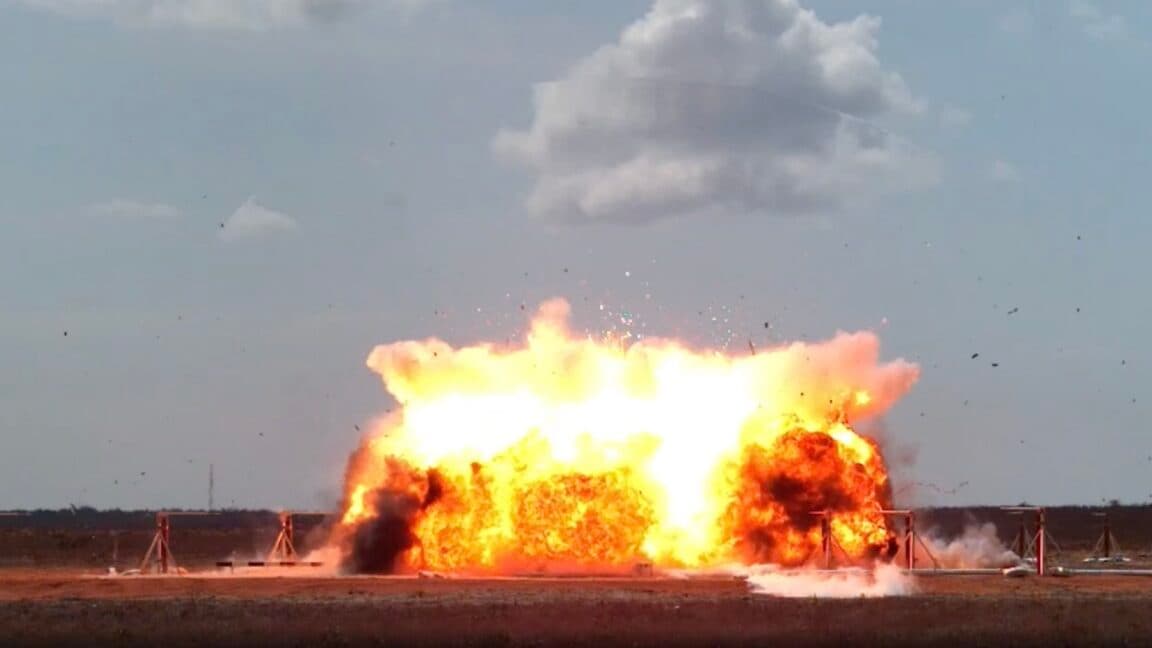
The testing approach is straightforward: “We put fuel in a rocket, blow it up in a remote location, and measure how big the boom is,” stated Jason Hopper, deputy manager for NASA's methalox assessment project at Stennis Space Center.
NASA elaborated that many tests involve intentionally rupturing the barrier between the two propellants to mimic a catastrophic failure scenario. As the mixed fluids detonate, instruments positioned on the test articles and across the test field measure the intensity of the blast wave at designated distances.
High-speed cameras capture the trajectories of debris fragments post-explosion and assess the thermal potency of the blast.
The tests commenced in January with two baseline explosions using C-4, recognized for its predictable blast characteristics. In February, methane and liquid oxygen were introduced, resulting in four tests with unmixed propellants. Future tests will involve mixing the propellants in conditions that simulate an actual launch failure scenario, starting with 2,000-pound test articles and scaling up to 20,000 pounds. The tests will focus on two failure modes: a transfer tube failure and a wall failure between the two propellant tanks.
Engineers will use the results to evaluate the explosive potential of larger rockets, such as SpaceX’s Starship, which holds over 10.8 million pounds of propellant at liftoff.
Nasa provided additional details on the testing process in a recent post on its website, stating that the tests are expected to conclude in June. The findings are anticipated to influence launch site planning, safety protocols, and safety requirements for years to come.
Currently, the Space Force treats any methalox rocket as having “100 percent TNT blast equivalency,” maintaining an extensive safety zone around the launch area. According to Chatman, preliminary studies indicate that the required keep-out zone may eventually decrease, although the extent will not be known until the test outcomes are analyzed.
Liquid oxygen and methane are highly miscible, meaning they mix easily, which raises the risk of a “condensed phase detonation” that could produce “significantly higher overpressures” compared to rockets using liquid hydrogen or kerosene fuels. Small-scale mixtures of liquid oxygen and liquefied natural gas have demonstrated a wide detonable range with yields greater than TNT, NASA reported in 2023.
SpaceX has also conducted its own methalox detonation testing. The company claims that the government relies on overly cautious methods for determining blast danger areas due to a lack of data for precise calculations. As a result, the default clear zones for LOX/methane rockets have been set larger than necessary, potentially disrupting operations.
Industry insights suggest that the government should adjust its TNT blast equivalency to no more than 25 percent, which would significantly reduce the size of the safety zones around launch pads, according to the Commercial Space Federation, a lobbying group representing members like SpaceX and Blue Origin who operate methane-fueled rockets.
In a written statement to Congress in 2023, the federation encouraged the government to utilize “existing industry data” to evaluate the explosive yield of methane and liquid oxygen instead of investing federal funds in independent testing. Ultimately, NASA, the Space Force, and the FAA concluded that conducting their own tests was a worthwhile investment.